B2B Credit Approval Workflow: How to Set Approval Tiers and Delegation of Authority
A B2B credit approval workflow decides who can say yes to which exposure. Learn how to build approval tiers, delegation of authority, escalation rules and audit trails.
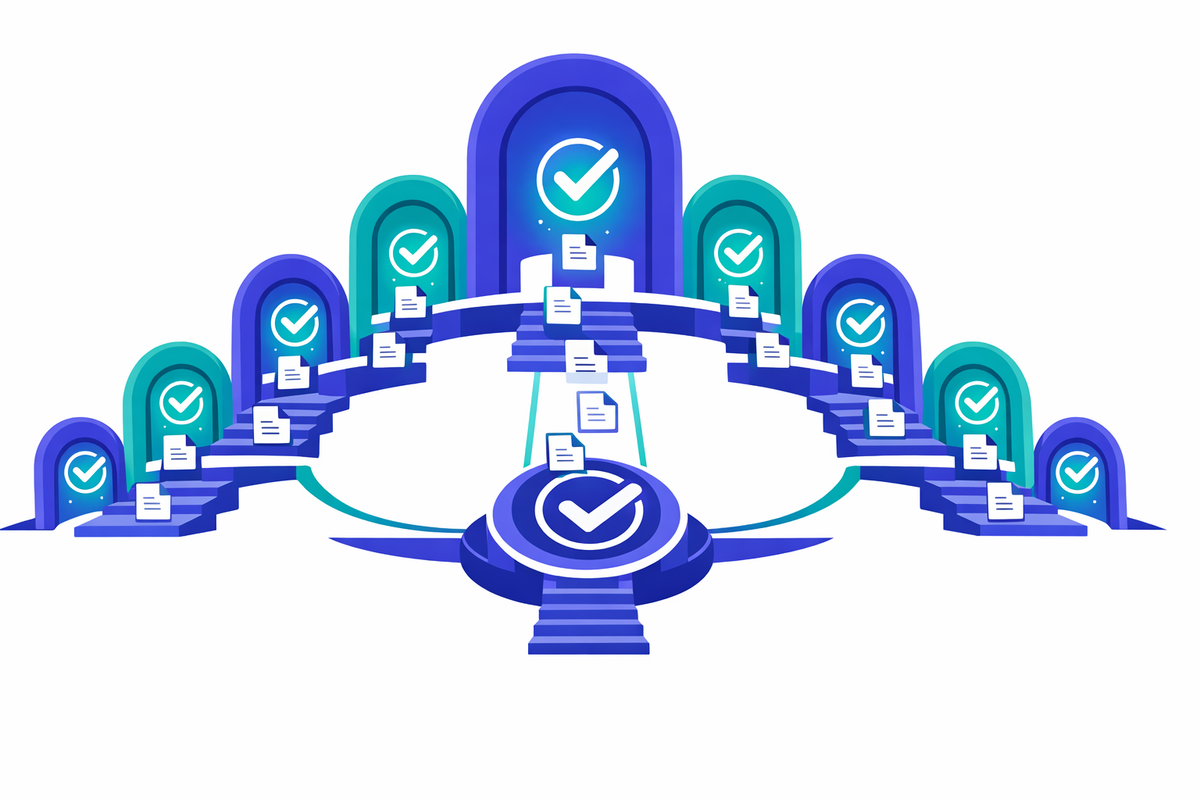
B2B Credit Approval Workflow: How to Set Approval Tiers and Delegation of Authority
Every company that sells on credit makes the same decision hundreds of times a year: should we ship this order to this buyer on these terms? The part that often goes unexamined is not what gets decided but who gets to decide it. A salesperson who is paid on revenue, a credit analyst who is measured on bad debt, and a CFO who signs off on the reserve all have a stake in the answer, and they rarely want the same thing.
A credit approval workflow is the structure that resolves this. It defines which decisions can be made by whom, at what exposure level, with what evidence, and with what escalation path. Done well, it makes decisions faster for routine buyers and more careful for risky ones. Done badly - or not done at all - it produces two failure modes at once: slow approvals that frustrate sales, and informal exceptions that quietly accumulate risk.
This guide covers how to design a B2B credit approval workflow: approval tiers, delegation of authority, escalation triggers, exception handling, and the audit trail that ties it together. It builds on our guides to building a B2B credit policy and setting credit limits.
What Is a Credit Approval Workflow?
A credit approval workflow is the documented path a credit request follows from submission to decision. It answers five questions:
- Who can submit a request (sales, customer service, the buyer through a portal)?
- What information must be attached before the request is reviewed?
- Who reviews it, and what are they checking?
- Who has authority to approve, based on the size and risk of the exposure?
- What is recorded, so the decision can be reviewed later?
The second concept, delegation of authority (often shortened to DoA), is the part of the workflow that assigns approval power. It is usually expressed as a matrix: individuals or roles on one axis, exposure thresholds and risk categories on the other. If your credit policy says what you are willing to do, the delegation of authority says who is allowed to do it on the company's behalf.
Why this matters more than it looks
Credit limits and payment terms get most of the attention in credit policy. But a limit that anyone can override is not really a limit. The approval workflow is what turns policy into behavior. Three things tend to go wrong without it:
- Authority creep. Over time, a sales director who "just needs this one order through" gets informal override power, and the exception becomes the norm.
- Inconsistent decisions. Two similar buyers get different terms because they went to different approvers, which creates both risk and fairness problems.
- No accountability. When a receivable goes bad, nobody can reconstruct who approved the exposure, on what evidence, or under what limit.
Why Approval Design Is a Credit Risk Control
It is tempting to treat approval workflows as an administrative matter. They are a control. A good buyer risk assessment only reduces losses if its conclusions actually govern what gets shipped.
Consider the structure of incentives. Sales is rewarded for closing orders. Finance is rewarded for collecting cash. Neither group is wrong, but if the same person can both win an order and approve the credit that funds it, the check is effectively gone. This is the classic segregation of duties problem, and it appears in credit in a specific form: the person who benefits from approval should not be the person who grants it.
This does not mean sales should be excluded from the process. It means sales provides context - relationship history, strategic importance, competitive pressure - while credit owns the risk decision, and senior finance owns the decisions that could materially affect the balance sheet.
The Building Blocks of an Approval Workflow
Before drawing a matrix, it helps to be clear about the inputs and roles involved.
Standard request package
Every request that enters the workflow should carry the same minimum information. Without it, approvers waste time chasing data, and decisions get made on incomplete evidence. A reasonable package includes:
- Legal entity name, registration details and address, verified rather than copied from an email signature
- The requested credit limit and payment terms
- The expected order pattern (first order size, frequency, seasonality)
- A completed credit application with ownership and trade reference details
- Results of your buyer verification checks
- Any existing exposure to the same buyer or to linked entities (see group credit exposure)
- A note from the sales owner explaining commercial context, if relevant
Roles
Most workflows involve some combination of the following. Smaller companies may have one person wearing several hats; the point is that the functions stay distinct.
- Requester - usually sales or account management.
- Credit analyst - gathers data, scores the buyer, recommends a limit and terms.
- Credit manager - approves within a defined range and handles most exceptions.
- Finance leadership (controller, CFO) - approves larger exposures and policy exceptions.
- Risk or credit committee - reviews the largest or most unusual exposures, where one exists.
Designing Approval Tiers
Approval tiers are the core of the workflow. The principle is simple: the more you could lose, the more senior the decision. The practical work is deciding what "more" means.
Step 1: Pick the dimensions that drive tiering
Exposure amount is the obvious dimension, but it should not be the only one. Useful tiering dimensions include:
- Total exposure to the buyer or group, including open orders and not-yet-invoiced shipments, not just current receivables
- Buyer risk grade from your internal scoring (a small exposure to a high-risk buyer may deserve more scrutiny than a larger exposure to a strong one)
- Payment terms requested (longer terms extend the period of risk)
- Buyer type (new versus existing, thin-file versus established)
- Geography, where country risk or sanctions exposure changes the picture
- Security in place, such as a guarantee, letter of credit or credit insurance
Step 2: Set the thresholds from your own capacity, not from habit
Many companies inherit thresholds that nobody can explain. A better approach is to anchor them to your own financial capacity: a share of equity, annual revenue, or the reserve you can absorb without disrupting the business. Our guide on customer concentration risk covers how to think about the size of a single exposure relative to the whole.
We are deliberately not publishing example dollar thresholds here. The right numbers depend on your margins, your reserve capacity, your industry, and your insurance position. What matters is that the tiers are explicit, written down, and tied to a rationale that finance leadership has signed off.
Step 3: Build the matrix
A simple illustrative structure looks like this (the tiers are described qualitatively because the specific thresholds are company-specific):
| Tier | Typical scope | Who approves |
|---|---|---|
| Tier 1 | Low exposure, strong or standard-grade buyer, standard terms | Credit analyst, ideally with automated rules |
| Tier 2 | Moderate exposure, or any buyer outside standard grade | Credit manager |
| Tier 3 | High exposure, extended terms, or higher-risk geography | Finance leadership (controller or CFO) |
| Tier 4 | Exposure that is material relative to equity or revenue, or any policy exception on a large account | Credit committee or CEO and CFO jointly |
Two design points make the matrix work in practice:
- Approve on the higher of the dimensions. If the amount puts a request in Tier 2 but the risk grade puts it in Tier 3, it goes to Tier 3.
- Count the total, not the increment. An increase from a small limit to a much larger one should be tiered on the new total, not on the size of the step. Otherwise a large exposure can be built up through a series of small "increases", each approved at a low level.
Want to speed up the evidence side of approvals? Run a buyer check on BuyersIntelligence.ai - verify the entity, review risk signals and attach the result to your request in minutes. Free to start.
Automating the Easy Decisions
A workflow that sends every request to a human approver will be slow, and slow approvals push sales toward workarounds. The goal is to reserve human attention for the cases that need it.
For the lowest tier, consider rules-based auto-approval. The conditions might include:
- Buyer entity verified and active
- No adverse flags in screening (including sanctions screening)
- Requested limit within a small, pre-set band for the buyer's grade
- Standard payment terms
- No existing past-due balances
If every condition is met, the system approves and logs the decision. If any condition fails, the request routes to a person. This gives sales a fast answer for routine buyers and gives analysts time for the harder cases.
Auto-approval should be reviewed periodically. Sample approved requests, check how those buyers have paid, and tighten the rules if performance is worse than expected. For a deeper look at how scoring supports this, see our comparison of traditional versus AI-powered credit scoring.
Escalation Rules
Tiers handle the normal case. Escalation rules handle the situations where a request should move up regardless of size. Common triggers include:
- Adverse findings - negative news, litigation, lien filings, or signs of financial distress
- Ownership issues - opaque ownership or unresolved questions from beneficial ownership verification
- Behavioral warning signs - deteriorating payment behavior, sudden order surges, or the patterns described in our article on bust-out fraud
- Requests to release a hold - lifting a credit hold should normally need equal or higher authority than the person who applied it
- Repeated exceptions for the same buyer or the same requester
It helps to write escalation triggers as a short, objective list. Subjective language such as "if something seems off" leaves too much room for inconsistency.
Handling Exceptions Without Breaking the System
No workflow survives contact with real commercial pressure unchanged. There will be strategic accounts, urgent shipments and deals that do not fit the grid. The question is not whether to allow exceptions but how to keep them visible and bounded.
Principles for a healthy exception process
- Exceptions need a named approver and a written reason. "Sales requested it" is a source, not a reason.
- Exceptions are time-limited. An exception to approve a larger limit for a seasonal peak should expire, and the limit should revert unless it is re-approved.
- Exceptions require a compensating control. That might be a shorter payment term, a guarantee, partial prepayment, credit insurance cover or tighter monitoring.
- Exceptions are reported. Review exception volume and outcomes regularly with finance leadership. A rising count is a sign the policy no longer fits the business, or that authority is being bypassed.
The "emergency order" problem
Urgent orders are where discipline most often slips. A buyer wants a shipment today, the approver is unavailable, and the order goes out on the strength of a verbal assurance. Build the urgent path into the workflow rather than leaving it to improvisation: define who can approve out of hours, set a ceiling on what an emergency approval can cover, and require a full review within a fixed window afterward. If the fast path is the only path that works, people will use it for everything.
Delegation, Absence and Conflict of Interest
Three operational details tend to be missed until they cause a problem.
Cover for absence
Approvers go on leave. If the workflow has no named delegate, requests stall or get routed informally to whoever is available. Define alternates for each tier, and make sure delegated authority is no broader than the original.
Conflict of interest
The rule is simple: nobody approves a request in which they have a personal or commercial stake. In practice that means a sales leader whose bonus depends on the account should not approve its credit limit, and a related-party buyer should always go to a higher tier. State this explicitly in the policy.
Authority reviews
Delegations should be reviewed at least annually and whenever roles change. People get promoted, leave, or move teams, and their approval rights often stay behind. An authority matrix that was accurate two years ago is rarely accurate now.
Documentation and Audit Trail
If a decision cannot be reconstructed, it cannot be learned from. For every approved request, the record should show:
- Who requested, who analyzed and who approved, with timestamps
- The evidence reviewed and the buyer's risk grade at the time
- The limit, terms and any security granted
- Any conditions attached (review dates, required guarantees, reduced limits)
- Any exception granted and the compensating control
This record serves several purposes. It supports internal and external audit, it helps you review whether your risk grades are predictive, and it gives you a defensible position if a decision is challenged. It also supports bad debt analysis: when a loss occurs, you can see whether the process failed, the information failed, or the outcome was a risk the company knowingly accepted.
Connecting Approval to Ongoing Monitoring
Approval is a point-in-time event. The buyer's circumstances keep changing after it. A mature workflow therefore includes re-approval triggers:
- A scheduled review date for each limit, driven by buyer risk grade
- A review when monitoring alerts fire, such as new legal filings, ownership changes or rating shifts
- A review when the buyer's utilization approaches or exceeds the limit
- A review when the buyer is acquired, as covered in our guide to change of control credit risk
Re-approvals should follow the same tier rules as initial approvals. A limit that was approved at Tier 2 and has drifted up through informal increases should be re-tiered on its current size.
A Practical Checklist for Your Workflow
Use this list to assess your current approval process:
- Is there a written delegation of authority matrix, approved by finance leadership?
- Are tiers based on total exposure and risk grade, not just the size of the latest increase?
- Does every request carry a standard evidence package?
- Are routine low-risk requests auto-approved by rules, with human review for the rest?
- Are escalation triggers written as objective conditions?
- Does anyone who benefits commercially from a deal also hold approval power over its credit?
- Do exceptions require a named approver, a reason, an expiry date and a compensating control?
- Is there a defined, bounded process for urgent or out-of-hours approvals?
- Are alternates named for each approver?
- Are delegations reviewed at least yearly and after role changes?
- Is every decision logged with evidence, approver and conditions?
- Do limits have review dates and monitoring-driven re-approval triggers?
Common Mistakes
- Tiering on increments instead of totals. This lets large exposures be built through small approvals.
- One approver for everything. It creates a bottleneck and a single point of failure.
- Letting sales hold the final say. Commercial context matters, but the risk decision needs independence.
- Overly complex matrices. If nobody can remember the rules, they will be ignored. Start with three or four tiers.
- No expiry on exceptions. Temporary approvals become permanent limits.
- Thresholds nobody can justify. Tie them to capacity, and revisit them as the business grows.
- Treating the workflow as paperwork. The value is in using the logged data to improve limits, grades and rules over time.
Where to Start
You do not need a large system to improve this. A reasonable first pass:
- Write down who can approve what today, in practice, not as the policy claims.
- Compare that to what your credit policy says. The gaps are your first fixes.
- Define three or four tiers, anchored to your capacity to absorb a loss.
- Standardize the request package.
- Start logging decisions in one place, even if it is a shared spreadsheet at first.
- Add rules-based auto-approval for the simplest cases once the data is clean.
The Bottom Line
A credit approval workflow is how a credit policy becomes real. Approval tiers match the level of scrutiny to the size and risk of the exposure, delegation of authority makes it clear who is accountable, escalation rules catch the cases that need a second look, and an audit trail turns every decision into something you can learn from. The aim is not to slow sales down. It is to make routine decisions quick, risky decisions careful, and exceptions visible.
The quality of every approval depends on the quality of the evidence behind it. If your reviewers are working from partial or outdated buyer information, even the best-designed matrix will approve the wrong exposures.
Ready to give your approvers better evidence? Check any B2B buyer on BuyersIntelligence.ai - verify the entity, trace ownership and see risk signals before you approve. Free to start.
This article is general information about credit operations and is not legal, accounting or financial advice. Approval thresholds and internal controls should be set with your finance and legal advisers.
Stop guessing about buyer risk. Get instant buyer intelligence.
Try BuyersIntelligence.ai - Free →