Country Risk Guide: Selling on Credit to Southeast Asia
Extending trade credit to buyers in Southeast Asia? This country risk guide covers payment culture, legal frameworks, and risk mitigation strategies for Vietnam, Thailand, Indonesia, the Philippines, and Malaysia.
Country Risk Guide: Selling on Credit to Southeast Asia
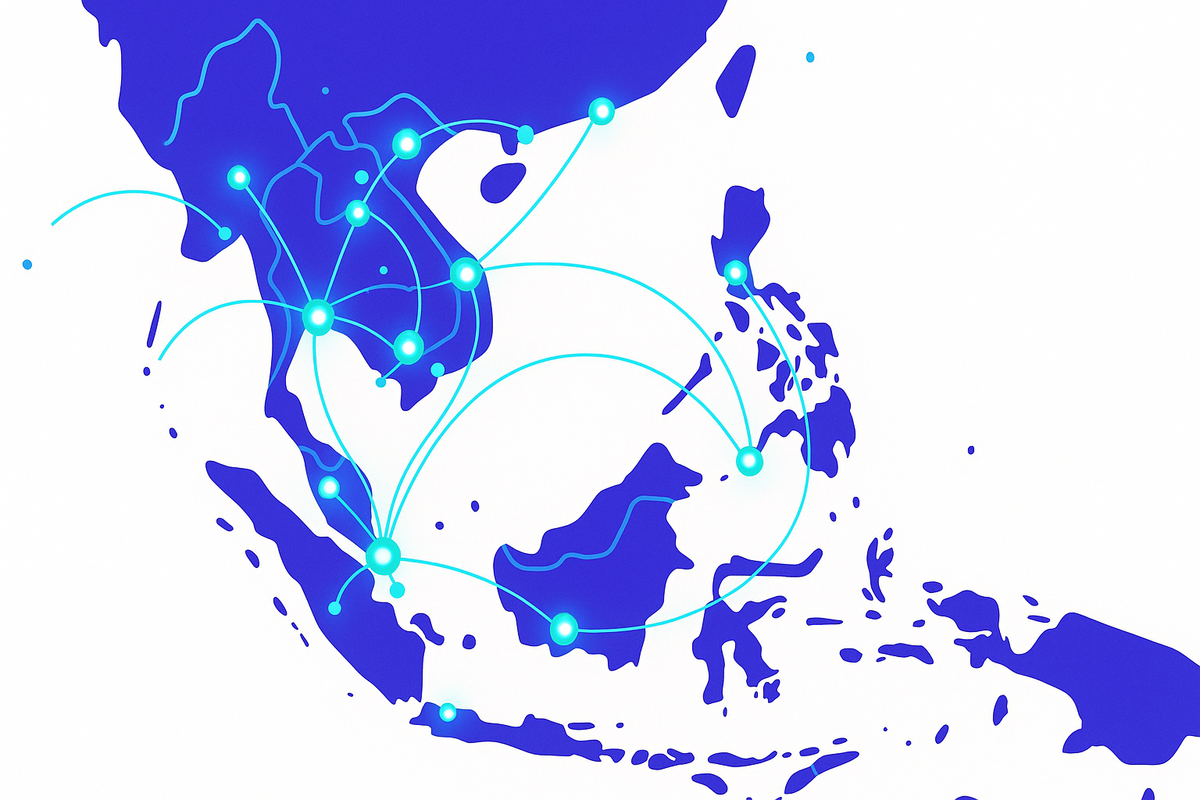
Southeast Asia is one of the fastest-growing B2B trade corridors in the world. With a combined GDP exceeding $3.8 trillion and a rapidly digitizing economy, the region offers enormous opportunity for exporters and wholesalers looking to expand their buyer base.
But selling on credit to buyers in Southeast Asia comes with a unique set of country risk factors that many Western finance teams underestimate. Payment cultures vary dramatically from country to country. Legal enforcement of unpaid invoices ranges from straightforward to practically impossible. And the gap between a buyer's apparent size and their actual creditworthiness can be wider than you expect.
This guide breaks down country risk for the five largest B2B trade markets in Southeast Asia - Vietnam, Thailand, Indonesia, the Philippines, and Malaysia - and gives you practical frameworks for extending credit without exposing your receivables to unnecessary risk.
What Is Country Risk in B2B Trade?
Country risk refers to the collection of factors that make extending credit to buyers in a specific country more or less risky than doing business domestically. It goes beyond the individual buyer's creditworthiness and includes:
- Political stability - regime changes, sanctions, trade policy shifts
- Currency risk - exchange rate volatility and capital controls
- Legal enforcement - how easy (or hard) it is to collect on unpaid invoices
- Payment culture - typical payment behavior, tolerance for late payment
- Regulatory environment - import/export restrictions, foreign exchange rules
- Economic fundamentals - GDP growth, inflation, banking system health
For B2B sellers extending trade credit, country risk is the layer that sits on top of individual buyer risk assessment. You might have a buyer with a strong balance sheet, but if the country's legal system makes debt collection nearly impossible, your credit exposure is higher than it appears.
Why Southeast Asia Deserves Special Attention
Southeast Asia is not a monolith. The ASEAN bloc contains economies at vastly different stages of development, with different legal traditions, languages, and business cultures. What works when selling to a buyer in Singapore will not work for a buyer in Vietnam or the Philippines.
Three factors make country risk particularly important in this region:
1. Rapid growth attracts inexperienced buyers. Southeast Asia's booming e-commerce and manufacturing sectors mean many buyers are newer businesses without established credit histories. Traditional business credit checks often return thin files.
2. Cross-border legal enforcement is weak. Unlike the EU, ASEAN has no unified commercial court system. Enforcing a debt judgment across borders is expensive and slow.
3. Payment culture varies enormously. In some markets, paying 30 days late is considered normal. In others, it signals serious financial trouble. Knowing the difference is critical.
Vietnam: High Growth, High Complexity
Risk Level: Medium-High
Vietnam is Southeast Asia's manufacturing darling. GDP growth has averaged 6-7% annually, and the country has become a major supplier in electronics, textiles, and furniture. For B2B sellers, Vietnam represents a massive opportunity - but credit extension requires caution.
Payment Culture
Vietnamese businesses tend to negotiate aggressively on payment terms. Net 60 and Net 90 are common requests, and late payment is culturally tolerated to a greater degree than in Western markets. Average days sales outstanding (DSO) for B2B transactions in Vietnam runs 15-30 days beyond agreed terms.
Legal Environment
Vietnam's legal system is based on civil law, and commercial dispute resolution has improved significantly in recent years. However, enforcing a foreign judgment remains difficult. International arbitration (typically through the Vietnam International Arbitration Centre or Singapore's SIAC) is the preferred route, but enforcement of arbitral awards can still be slow.
Key Risks
- State-owned enterprises (SOEs) are major buyers but can be slow payers with limited legal recourse
- Currency controls - the Vietnamese dong (VND) is managed by the State Bank of Vietnam, and repatriation of funds can face bureaucratic delays
- Corporate transparency - financial statements from private Vietnamese companies are often unreliable or unavailable
- Rapid business formation and dissolution - new companies can appear and disappear quickly
Mitigation Strategies
- Request payment in USD or use currency hedging for VND-denominated receivables
- Start with shorter payment terms (Net 30) and extend only after establishing a payment track record
- Use continuous buyer monitoring rather than point-in-time checks - Vietnamese companies' financial situations can change rapidly
- Consider requiring letters of credit for initial transactions above $50,000
Want to assess buyer risk in Vietnam before extending credit? BuyersIntelligence.ai provides real-time buyer risk profiles that go beyond traditional credit reports - covering payment behavior, legal standing, and financial health across Southeast Asian markets.
Thailand: Mature Market, Moderate Risk
Risk Level: Medium
Thailand has one of the more mature and stable economies in Southeast Asia. Its banking system is well-regulated, corporate governance standards are higher than regional averages, and the legal framework for commercial disputes is relatively functional.
Payment Culture
Thai businesses generally respect agreed payment terms, though Net 60 is standard in many industries (particularly automotive, electronics, and agriculture). Late payment penalties are culturally accepted but rarely enforced aggressively. Building personal relationships (the concept of "kreng jai" - consideration for others) plays a significant role in business dealings, including payment behavior.
Legal Environment
Thailand's commercial courts are reasonably efficient by regional standards. Foreign judgments are not directly enforceable, but Thai courts will consider them as evidence in a new proceeding. Arbitration awards under the New York Convention are enforceable, making arbitration clauses essential in contracts.
Key Risks
- Political instability - Thailand has experienced multiple coups and political disruptions, though the business environment has remained surprisingly resilient through these events
- Family-owned conglomerates - many large Thai businesses are family-controlled with complex ownership structures that can obscure financial health
- Agricultural sector volatility - if your buyers are in agriculture or food processing, commodity price swings directly impact their payment capacity
Mitigation Strategies
- Include arbitration clauses (preferably Singapore or Hong Kong seat) in all contracts
- Verify corporate registration through Thailand's Department of Business Development (DBD) - they provide publicly accessible company filings
- For new relationships, request bank references from Thai commercial banks (Bangkok Bank, Kasikornbank, SCB)
- Monitor political developments that could affect trade flows or currency stability
Indonesia: Massive Market, Fragmented Risk
Risk Level: Medium-High
Indonesia is Southeast Asia's largest economy by GDP and population (280+ million people). The B2B opportunity is enormous - but the country's geographic fragmentation (17,000+ islands), regulatory complexity, and variable business practices create significant country risk for credit extension.
Payment Culture
Payment behavior in Indonesia varies significantly by region and industry. In Jakarta and major cities, larger companies generally adhere to agreed terms (typically Net 30-60). Outside major urban centers, payment delays of 30-60 days beyond terms are common and not considered unusual.
Cash flow management in Indonesian businesses is often less sophisticated than in more developed markets, meaning even solvent companies may pay late simply due to poor internal processes rather than financial distress.
Legal Environment
Indonesia's commercial legal system has improved but remains challenging for foreign creditors. Court proceedings are conducted in Bahasa Indonesia, and foreign legal representation is restricted. Corruption in the judiciary, while improving, remains a concern. The country has a functional arbitration framework through BANI (Badan Arbitrase Nasional Indonesia), and New York Convention awards are enforceable - though the process can take 6-12 months.
Key Risks
- Regulatory complexity - import regulations, licensing requirements, and foreign ownership restrictions can change with limited notice
- Currency volatility - the Indonesian rupiah (IDR) has experienced significant fluctuations, particularly during global risk-off events
- Conglomerate structures - many Indonesian businesses operate through complex group structures that make it difficult to assess which entity actually holds the assets
- Geographic fragmentation - verifying a buyer located in Surabaya or Medan is significantly harder than one in Jakarta
Mitigation Strategies
- Conduct thorough KYB (Know Your Business) checks that verify the specific legal entity you are contracting with
- Denominate contracts in USD where possible to avoid rupiah exposure
- Use trade credit insurance for larger exposures - several global insurers have established Indonesian operations
- Build relationships with local trade associations in your industry vertical for buyer reputation checks
The Philippines: Relationship-Driven, Legally Challenging
Risk Level: Medium-High
The Philippines has a large, English-speaking workforce and strong ties to Western business practices - which can lull sellers into underestimating country risk. While the cultural fit may feel familiar, the legal and regulatory environment for debt collection is among the most challenging in the region.
Payment Culture
Filipino business culture is highly relationship-driven. Payment behavior is closely tied to the quality of the business relationship, and personal trust often matters more than contractual terms. Net 30 to Net 60 are standard, but stretching to 90+ days is common, particularly for smaller businesses. Direct confrontation over late payment is culturally uncomfortable, which can make collections challenging.
Legal Environment
The Philippines' court system is notoriously slow. Commercial disputes can take 3-7 years to resolve through the courts. The country's Alternative Dispute Resolution Act of 2004 provides a framework for arbitration, but enforcement remains slow. Many sellers find that the practical cost of legal enforcement exceeds the value of the receivable.
Key Risks
- Slow legal enforcement - the single biggest risk factor. Even with a valid judgment, enforcement can take years
- Natural disaster exposure - typhoons, earthquakes, and volcanic activity can disrupt business operations and payment capacity with little warning
- BPO dependency - many Filipino businesses are tied to the business process outsourcing industry, creating concentration risk
- Complex corporate structures - family-owned businesses with intertwined personal and corporate finances are common
Mitigation Strategies
- Keep initial credit limits conservative and increase only after 3-6 payment cycles
- Invest in relationship building - regular communication significantly reduces default risk in the Philippines
- Consider credit insurance for exposures above your risk tolerance
- Build natural disaster risk into your payment terms - consider force majeure clauses that protect both parties
- Use buyer intelligence platforms that monitor real-time signals rather than relying on static credit reports
Malaysia: Lower Risk, Higher Standards
Risk Level: Low-Medium
Malaysia is often considered the "easiest" Southeast Asian market for extending trade credit. Strong legal institutions (influenced by British common law), a well-regulated banking sector, high corporate governance standards, and a relatively stable currency make it the most familiar environment for Western sellers.
Payment Culture
Malaysian businesses generally adhere to agreed payment terms. Net 30 is standard in most industries, and late payment beyond 15 days is considered poor practice. The Malaysian credit bureau system (CTOS and CCRIS) provides relatively comprehensive credit information on Malaysian companies, making credit scoring more reliable than in most other ASEAN markets.
Legal Environment
Malaysia's commercial courts are efficient by regional standards, and the country's legal system (based on English common law) is familiar to Western businesses. Foreign arbitral awards are enforceable under the New York Convention. The Insolvency Act 1967 (amended 2017) provides a clear framework for creditor rights in bankruptcy proceedings.
Key Risks
- Government-linked companies (GLCs) - major players in many sectors but can have opaque decision-making processes
- Ethnic business networks - understanding the Malay/Chinese/Indian business dynamics is important for relationship building
- Commodity exposure - Malaysia's economy is tied to palm oil, rubber, and petroleum, making some sectors vulnerable to commodity price swings
- Political transition risk - recent political instability has created some uncertainty, though business operations have remained largely unaffected
Mitigation Strategies
- Leverage CTOS credit reports for Malaysian buyer assessment
- Standard contractual protections (retention of title, interest on late payment) are generally enforceable
- For larger deals, Malaysian banks are experienced with letters of credit and bank guarantees
- Monitor buyer risk continuously even in this lower-risk market - company situations can change
Building a Country Risk Framework for Southeast Asia
Rather than treating Southeast Asia as a single market, build a tiered country risk framework that adjusts your credit policies by country:
Tier 1: Lower Risk (Malaysia, Singapore)
- Standard credit terms (Net 30-60)
- Normal buyer verification process
- Credit limits based on buyer financials
- Standard monitoring cadence (quarterly review)
Tier 2: Medium Risk (Thailand)
- Slightly conservative terms (Net 30-45, extend to 60 after track record)
- Enhanced buyer verification including bank references
- Credit limits at 75% of what you would offer a Tier 1 buyer with identical financials
- Monthly monitoring for larger exposures
Tier 3: Higher Risk (Vietnam, Indonesia, Philippines)
- Conservative initial terms (Net 30, advance payment for first orders)
- Full due diligence including site verification where practical
- Credit limits at 50% of Tier 1 equivalent
- Continuous monitoring with automated alerts
- Consider credit insurance or letters of credit for exposures above $25,000
Adjusting for Buyer Quality
Country risk sets the baseline, but individual buyer quality can move the needle. A well-established, publicly listed Indonesian conglomerate may actually be lower risk than a small, thinly capitalized Malaysian startup. Your framework should allow for adjustments based on:
- Buyer's years in business
- Audited financial statements availability
- Payment history with other suppliers
- Industry sector stability
- Ownership transparency
The Role of Technology in Managing Country Risk
Traditional country risk assessment relied on annual reports from rating agencies and trade credit insurers. These reports are useful for macro-level understanding but insufficient for making individual credit decisions.
Modern buyer intelligence tools combine country risk data with real-time buyer-level signals to give you a dynamic risk picture:
- Real-time financial monitoring - detect changes in a buyer's financial health as they happen, not months later
- Payment behavior tracking - see how a buyer is paying other suppliers, not just your invoices
- Regulatory and legal alerts - get notified about regulatory changes, legal proceedings, or sanctions that affect specific buyers or countries
- Currency and economic indicators - automated monitoring of exchange rates, capital controls, and economic indicators that could affect payment capacity
This shift from static country risk reports to dynamic, buyer-level intelligence is what separates finance teams that successfully scale their Southeast Asian receivables from those that get burned.
Ready to extend credit in Southeast Asia with confidence? BuyersIntelligence.ai combines country risk data with real-time buyer intelligence to help you make smarter credit decisions - whether your buyers are in Jakarta, Bangkok, or Ho Chi Minh City. Try it free.
Key Takeaways
-
Southeast Asia is not one market - treat each country as a distinct risk environment with its own payment culture, legal framework, and business norms
-
Legal enforcement is the critical variable - the biggest difference between Southeast Asian markets and Western ones is how hard it is to collect when things go wrong
-
Payment culture matters as much as credit data - understanding what "normal" payment behavior looks like in each country prevents you from misinterpreting signals
-
Start conservative, then expand - begin with tighter credit terms and lower limits, and ease them as you build payment history with specific buyers
-
Technology bridges the information gap - AI-powered buyer intelligence can compensate for the thinner credit data available in emerging markets
-
Country risk is a baseline, not a ceiling - great buyers exist in every market. Your framework should identify them while protecting you from the risks that are harder to see from the outside
Southeast Asia represents a generational opportunity for B2B sellers willing to navigate its complexity. The finance teams that build robust, country-aware credit processes now will be the ones capturing market share while their competitors sit on the sidelines.
Stop guessing about buyer risk. Get instant buyer intelligence.
Try BuyersIntelligence.ai - Free →