The Complete Guide to B2B Buyer Risk Assessment in 2026
Learn how to assess B2B buyer risk in 2026 with modern tools, data sources, and AI-powered approaches. A practical guide for finance teams extending trade credit.
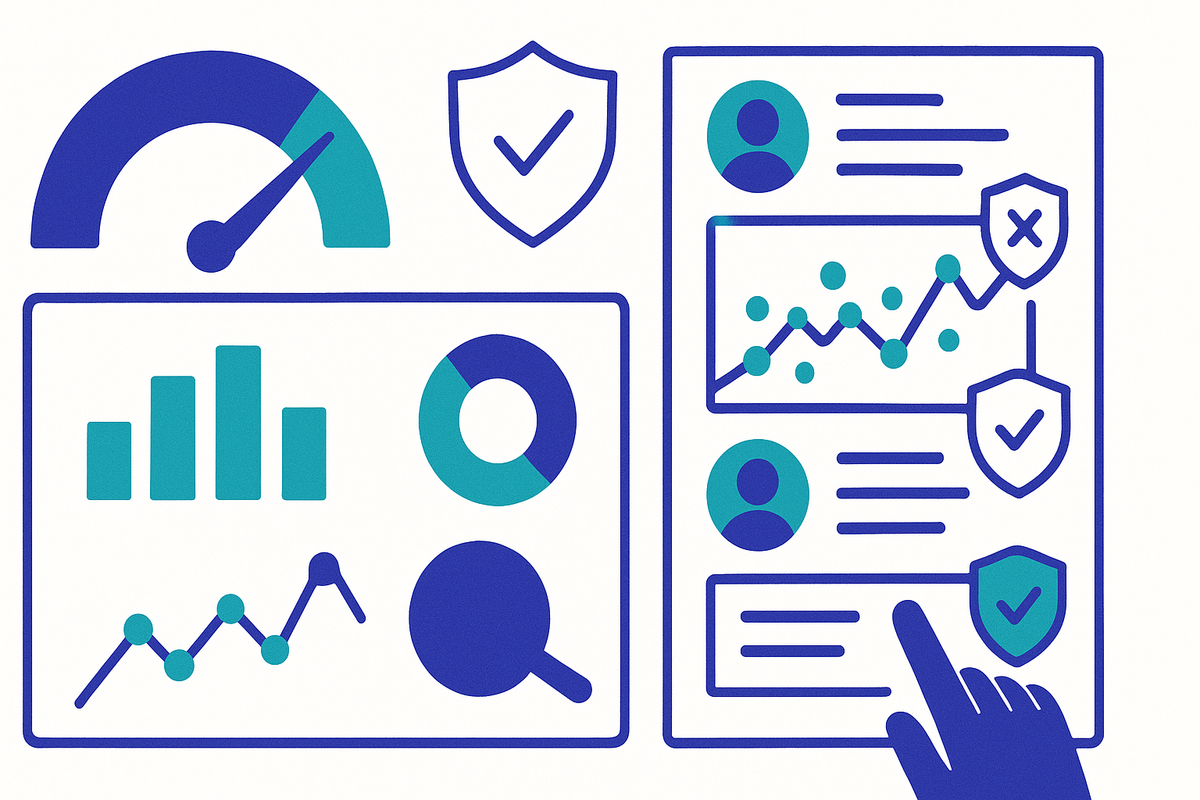
What Is B2B Buyer Risk Assessment?
Buyer risk assessment is the process of evaluating whether a business customer can - and will - pay for goods or services purchased on credit terms. For companies selling B2B on net 30, 60, or 90 day terms, getting this right is the difference between healthy growth and a cash flow crisis.
In 2026, buyer risk assessment has evolved well beyond pulling a single credit report and making a gut call. Modern finance teams combine financial data, behavioral signals, market intelligence, and AI-driven analysis to build a complete picture of buyer reliability.
This guide covers everything you need to know: what buyer risk actually means, which data sources matter, how to build a scalable assessment process, and where the industry is heading.
Why Buyer Risk Assessment Matters More Than Ever
The stakes are straightforward. When you extend trade credit, you're lending money. Every open invoice is an unsecured loan to your buyer. If they don't pay, you absorb the loss.
The numbers tell the story:
- B2B trade credit represents over $30 trillion in outstanding receivables globally
- Average days sales outstanding (DSO) for mid-market B2B companies ranges from 45 to 65 days
- Bad debt write-offs typically run 1-3% of revenue - but a single large default can be catastrophic
- Late payments affect more than 50% of B2B invoices, creating cascading cash flow problems
The cost of getting buyer risk assessment wrong isn't just the unpaid invoice. It's the downstream impact: strained supplier relationships, missed payroll, delayed investment, and in extreme cases, your own insolvency triggered by a customer's default.
If you're still relying on annual credit reviews and static reports, you're evaluating buyers with outdated methods that miss the signals that matter most.
The Core Components of Buyer Risk Assessment
A thorough buyer risk assessment evaluates risk across several dimensions. No single data point tells the full story.
Financial Health
This is the foundation. You need to understand your buyer's ability to pay:
- Financial statements - Revenue trends, profit margins, debt levels, cash reserves
- Credit scores and ratings - Business credit scores from bureaus, bank references
- Payment history - How they've paid other suppliers (trade references)
- Liquidity ratios - Current ratio, quick ratio, cash conversion cycle
- Debt-to-equity ratio - How leveraged the business is
Financial data gives you a snapshot, but it's backward-looking by nature. A company's last quarterly filing may not reflect what's happening today.
Behavioral Signals
How a buyer behaves tells you as much as their financials:
- Payment patterns - Are they paying you slower over time? Consistent or erratic?
- Order patterns - Sudden spikes in order volume can signal either growth or desperation
- Communication patterns - Going quiet often precedes payment problems
- Dispute frequency - Frequent disputes on invoices can be a stalling tactic
Market and Industry Risk
External factors affect buyer reliability:
- Industry health - Is the buyer's sector growing or contracting?
- Competitive position - Market leaders are generally safer than struggling competitors
- Regulatory changes - New regulations can disrupt entire industries overnight
- Economic conditions - Recession, interest rate changes, and inflation all affect payment behavior
Country and Political Risk
For international trade, geography adds another layer. Currency volatility, political instability, capital controls, and differing legal frameworks all impact whether you'll get paid. Understanding buyer risk in international trade is essential for exporters.
Operational Risk
Some risks are specific to the buyer-seller relationship:
- Concentration risk - How much of your revenue depends on this one buyer?
- Contract terms - Are payment terms, warranties, and dispute resolution clearly defined?
- Fulfillment complexity - More complex orders create more opportunities for disputes
How to Build a Buyer Risk Assessment Process
Knowing what to evaluate is one thing. Building a repeatable, scalable process is another. Here's a practical framework.
Step 1: Define Your Risk Appetite
Before assessing any buyer, establish your risk tolerance:
- What's the maximum credit you'll extend to a single buyer? This should be a function of your own cash reserves and the buyer's risk profile.
- What payment terms will you offer? Net 30 for low-risk buyers, prepayment or shorter terms for higher-risk ones.
- What's your acceptable bad debt rate? Most B2B companies target under 1% of revenue.
- What concentration limits will you set? A common rule: no single buyer exceeds 10-15% of total receivables.
Document these thresholds clearly. They become the guardrails your team uses when making credit decisions.
Step 2: Gather Data from Multiple Sources
Don't rely on a single data source. The most effective buyer risk assessments combine:
- Business credit reports from bureaus (D&B, Experian Business, Equifax Commercial)
- Financial statements directly from the buyer or via public filings
- Trade references from other suppliers
- Bank references for payment capacity
- Public records - liens, judgments, UCC filings, bankruptcy records
- News and media monitoring for reputational signals
- Your own AR data - payment history, dispute history, order trends
For a deeper look at the data sources that matter most, see our guide on top data sources for business credit checks.
Step 3: Score and Categorize
Translate your data into a structured risk score. This doesn't need to be complex:
Tier A - Low Risk (score 80-100) - Strong financials, consistent payment history, established business - Credit terms: Net 60-90, higher credit limits - Review frequency: Annually
Tier B - Medium Risk (score 50-79) - Adequate financials, generally pays on time, some concerns - Credit terms: Net 30-45, moderate credit limits - Review frequency: Quarterly
Tier C - High Risk (score 20-49) - Weak financials, payment delays, red flags present - Credit terms: Net 15 or prepayment, low credit limits - Review frequency: Monthly
Tier D - Unacceptable Risk (score below 20) - Serious financial distress, defaults, or fraud indicators - Credit terms: Prepayment only or decline
Want to check a buyer's risk profile in 60 seconds? Try BuyersIntelligence.ai - free buyer intelligence for B2B finance teams.
Step 4: Set Credit Terms Based on Risk
Match your terms to the risk tier:
| Risk Tier | Credit Limit | Payment Terms | Security Required |
|---|---|---|---|
| A - Low | Up to $500K | Net 60-90 | None |
| B - Medium | Up to $100K | Net 30-45 | Personal guarantee possible |
| C - High | Up to $25K | Net 15 / COD | Letter of credit or guarantee |
| D - Unacceptable | $0 | Prepayment only | Full prepayment |
These are guidelines, not rigid rules. A startup buyer with strong backing might warrant better terms than their credit score suggests. The assessment provides the baseline; human judgment handles the exceptions.
Step 5: Monitor Continuously
This is where most companies fail. They assess a buyer once - during onboarding - and then never look again until something goes wrong.
Continuous monitoring means:
- Automated alerts when a buyer's credit score changes
- Payment trend tracking - catching the slow drift from net-30 to net-45 to net-60
- News monitoring for layoffs, lawsuits, executive departures, or M&A activity
- Financial statement updates when new filings become available
- Peer benchmarking - how does this buyer's payment behavior compare to others in their industry?
The shift from periodic to continuous monitoring is one of the most impactful improvements a finance team can make. Problems rarely appear overnight. They build gradually, and continuous monitoring catches them early.
Traditional vs. AI-Powered Buyer Risk Assessment
The traditional approach to buyer risk assessment is manual, periodic, and reactive. A credit analyst pulls reports, reviews financials, makes a judgment call, and files it away until the next annual review (or until the buyer stops paying).
AI-powered approaches change the game in several ways:
Speed
Traditional assessment of a new buyer takes 2-5 business days. AI-powered tools can generate a preliminary risk score in minutes by aggregating data from multiple sources simultaneously. This matters when your sales team is waiting to close a deal.
Breadth of Data
Human analysts can realistically review 10-15 data points per buyer. AI systems process hundreds of signals - financial data, payment patterns, news sentiment, industry benchmarks, legal filings, web presence, and more - to build a more comprehensive picture.
Pattern Recognition
AI excels at detecting subtle patterns that humans miss. A 3% monthly increase in DSO across a buyer's industry might not trigger alarm bells for an analyst, but a machine learning model trained on default data recognizes it as an early warning signal.
Consistency
Human judgment varies by analyst, mood, workload, and relationship with the buyer. AI applies the same evaluation criteria consistently across every assessment. This doesn't eliminate the need for human judgment - it provides a consistent baseline.
Continuous Monitoring at Scale
No human team can continuously monitor thousands of buyers across dozens of data sources. AI makes this feasible, flagging changes in real-time rather than waiting for the next scheduled review.
For a detailed comparison, read our analysis of how AI is shaping B2B credit decisions.
Common Mistakes in Buyer Risk Assessment
Relying on a Single Data Source
A D&B report is useful but not sufficient. Credit bureau data can be outdated, incomplete, or missing entirely for smaller businesses. Combine bureau data with trade references, financial statements, and your own payment history for a complete picture.
Treating All Buyers the Same
A Fortune 500 company and a 2-year-old startup require fundamentally different assessment approaches. Your process should scale its depth to the risk and exposure involved.
Static Credit Limits
Setting a credit limit once and never adjusting it is a recipe for either over-exposure or missed revenue. Credit limits should be dynamic, increasing for buyers who consistently demonstrate reliability and decreasing when risk signals emerge.
Ignoring Concentration Risk
Even if your largest buyer is rated AAA, having 30% of your receivables with one customer is dangerous. Diversification applies to accounts receivable just as it does to investment portfolios.
Skipping Due Diligence Under Sales Pressure
"The buyer wants to place a $200K order and needs terms today." This pressure is real, and it's exactly when assessment shortcuts lead to losses. Build a process that's fast enough to support sales velocity without cutting corners on risk evaluation.
Not Documenting Decisions
When a credit decision is made based on judgment rather than data, document the reasoning. If that buyer later defaults, you need to understand what happened and adjust your process accordingly.
Key Metrics for Buyer Risk Assessment
Track these metrics to measure and improve your assessment process:
- Days Sales Outstanding (DSO) - overall and by buyer tier
- Bad debt rate - write-offs as a percentage of revenue
- Buyer default rate - percentage of buyers who default, segmented by risk tier
- Assessment accuracy - how often do your risk tier assignments predict actual payment behavior?
- Credit utilization - how much of the credit you've extended is actually being used?
- Time to decision - how long does it take to approve or decline a new buyer?
- Cure rate - when a buyer enters collections, how often do you recover the full amount?
Building Your 2026 Buyer Risk Assessment Stack
The tools available in 2026 make comprehensive buyer risk assessment accessible to companies of all sizes - not just enterprises with dedicated credit departments.
A modern assessment stack typically includes:
- Buyer intelligence platform - Aggregates data from multiple sources, provides risk scores, and enables continuous monitoring. This is the central hub.
- Credit bureau integrations - Direct feeds from D&B, Experian, Equifax for credit scores and reports.
- Financial data providers - For accessing buyer financial statements and filings.
- News and sentiment monitoring - Automated tracking of buyer mentions in news, social media, and industry publications.
- AR management software - Your own payment data is one of the most valuable inputs for buyer risk assessment.
- ERP integration - Connecting risk assessment to order management, invoicing, and collections workflows.
The goal is a system where risk assessment is embedded in your business process - not a separate, manual step that gets skipped when things get busy.
What's Next: The Future of Buyer Risk Assessment
Several trends are shaping where buyer risk assessment is heading:
Real-time data - The shift from periodic reports to continuous, real-time data feeds means risk assessments can update instantly when new information becomes available.
Open banking and data sharing - As open banking expands into B2B, buyers may consent to share financial data directly, providing more accurate and timely information than bureau reports.
Network effects - Platforms that aggregate payment behavior across thousands of buyer-seller relationships build increasingly accurate risk models. The more data, the better the predictions.
Embedded credit decisions - Risk assessment is moving from a standalone process to an embedded feature within procurement, invoicing, and payment platforms.
Predictive rather than reactive - The biggest shift is from asking "is this buyer risky?" to "will this buyer become risky?" Predictive models that forecast future payment behavior based on early signals are becoming the standard.
Conclusion
Buyer risk assessment in 2026 is no longer about pulling a credit report and hoping for the best. It's a continuous, data-driven process that combines financial analysis, behavioral signals, market intelligence, and AI-powered pattern recognition.
The companies that get this right extend credit confidently, grow their revenue, and avoid the catastrophic losses that come from unmanaged buyer risk. The ones that don't are playing a game of chance with their cash flow.
Whether you're building your assessment process from scratch or modernizing an existing one, the principles are the same: gather data from multiple sources, score consistently, set terms based on risk, and monitor continuously.
BuyersIntelligence.ai gives B2B finance teams instant access to comprehensive buyer risk profiles - combining credit data, financial signals, and AI-powered analysis in one platform. Check any buyer in 60 seconds.
Stop guessing about buyer risk. Get instant buyer intelligence.
Try BuyersIntelligence.ai - Free