Days Beyond Terms: How Payment Behavior Predicts B2B Buyer Default
Days beyond terms shows how a buyer actually pays versus how they promised to. Learn how to track payment behavior and use it as an early warning of B2B default.
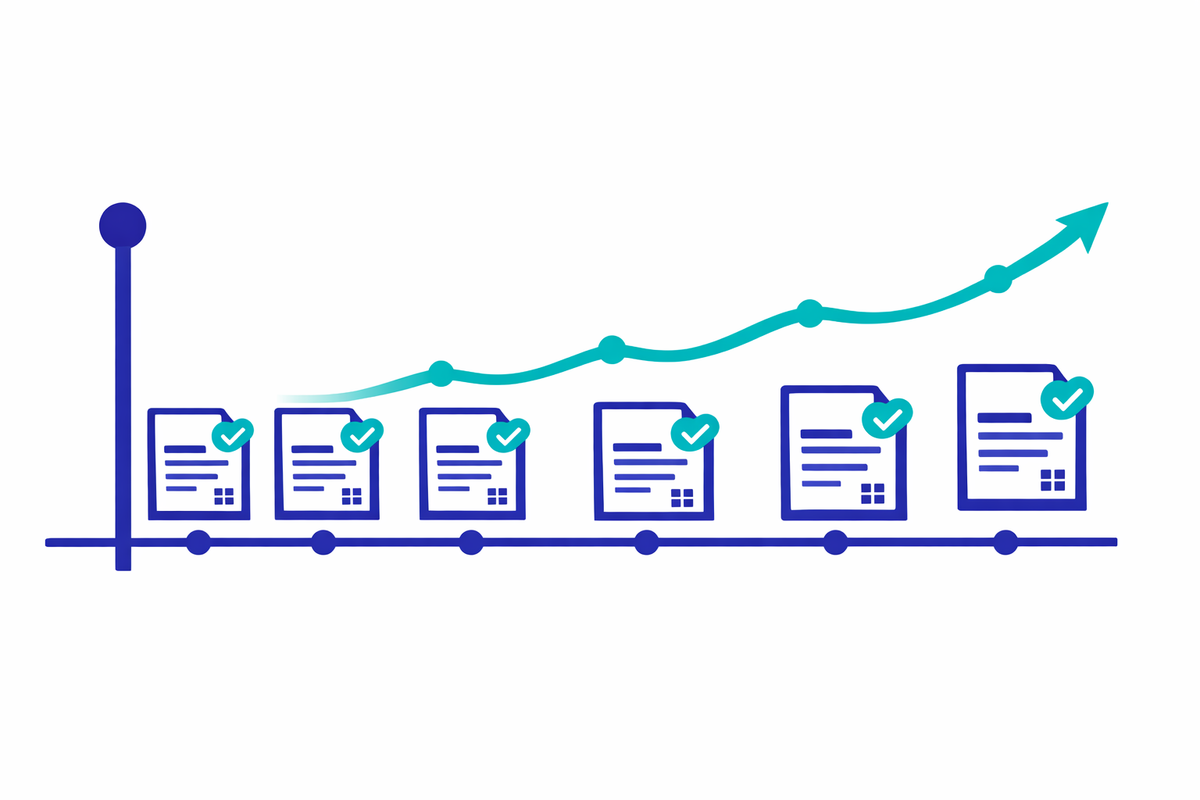
Days Beyond Terms: How Payment Behavior Predicts B2B Buyer Default
Most credit files tell you who a buyer was. Payment behavior tells you who the buyer is right now.
A financial statement can be six to twelve months old by the time you see it. A credit report may reflect a snapshot compiled weeks ago. But the way a buyer pays your invoices - early, on time, a few days late, or steadily later - updates with every single payment. That makes it one of the freshest and most practical signals you own, and you already own it. It sits in your ledger.
The cleanest way to read it is a metric called days beyond terms (DBT): the number of days, on average, that a buyer pays after the invoice due date. This guide explains how DBT works, how it differs from the metrics you probably already track, what patterns tend to precede default, and how to build payment-behavior monitoring into your credit process without needing a data science team.
What Are Days Beyond Terms?
Days beyond terms measures how late a buyer pays relative to the agreed payment terms. If an invoice is due on the 30th and the buyer pays on the 40th, that invoice was paid 10 days beyond terms. Averaged across payments, DBT gives you a single number describing a buyer's habit.
A few things make it more useful than it first appears:
- It is relative to the contract. A buyer on net 60 who pays in 65 days is 5 days beyond terms. A buyer on net 15 who pays in 25 days is 10 days beyond terms. Comparing them on raw payment days alone would mislead you.
- It isolates behavior from terms. Your own terms policy changes over time. DBT lets you compare a buyer against its own history even when terms change.
- It can be negative. A buyer who consistently pays five days early has a DBT of -5. That is a genuine positive signal, and it is worth recording.
Payment data also has a limit: it only describes what has already happened with you. A buyer that pays you promptly while quietly stretching other suppliers is not visible in your own DBT. We return to this blind spot later.
DBT vs DSO vs Aging: What Is the Difference?
If you already track days sales outstanding or run an aging report, DBT can sound redundant. It is not. Each metric answers a different question.
| Metric | What it measures | Level | Main limitation |
|---|---|---|---|
| DSO | Average time to collect across all sales | Portfolio | Blends good and bad payers; affected by sales timing |
| Aging report | How much is outstanding by age bucket | Portfolio and account | Snapshot of unpaid items; says little about paid history |
| Days beyond terms | How late a buyer pays versus terms | Buyer | Needs payment history; only reflects your own ledger |
DSO is useful for cash forecasting, and we cover how to bring it down in our guide on how to reduce days sales outstanding. The accounts receivable aging report shows what is unpaid today. But neither is built to describe an individual buyer's trajectory. DSO can look stable while one large customer is slipping, because other customers pay faster and mask the drift. DBT, tracked per buyer, does not have that problem.
Why Payment Behavior Is a Credit Signal
Late payment is not always a sign of distress. Some buyers pay late as a matter of routine. Their accounts payable runs on a fixed weekly or monthly cycle, or their approval process is slow, or they simply treat your terms as a suggestion. For those buyers, being 10 days late every time is a stable, priced-in behavior.
What matters for credit risk is change. A buyer's payment pattern usually reflects its liquidity. When cash gets tight, a company has to decide which suppliers to pay first. Suppliers that are critical to operations, or that are known to enforce terms, get paid on time. Others get paid later. If you notice your invoices sliding from "on time" to "a week late" to "three weeks late", the buyer may be putting you lower in the queue because it is managing a cash shortfall.
This is why payment behavior sits alongside the signals we describe in our guide to spotting financial distress in B2B buyers. It is often one of the first indicators visible to a supplier, well before a filing, a public judgment, or a downgrade.
Payment Patterns That Deserve Attention
Averages hide a lot. The shape of the pattern is often more informative than the number. Here are the patterns credit teams commonly watch for.
Steady drift
DBT rises gradually over several months: 0 days, then 3, then 6, then 10. No single payment is alarming, but the direction is. A steady drift often points to deteriorating liquidity or a shift in how the buyer prioritizes suppliers.
Sudden step change
A buyer that has paid within a day or two of the due date for years suddenly pays two weeks late. When a stable pattern breaks, ask why. It could be an ERP migration or a change in accounts payable staff - or a cash problem. A short call usually tells you which.
Increasing variability
Payments become erratic: some on time, some very late, with no clear logic. Variability can indicate that the buyer is paying whichever supplier is applying the most pressure that week, which is a recognizable sign of cash rationing.
Partial payments and short-pays
The buyer starts paying part of an invoice, or pays invoices in a different order than they were issued. Partial payments can reflect legitimate disputes, but they can also signal that the buyer is spreading limited cash thinly. Separate disputes from liquidity by checking whether the buyer actually raised a dispute. Our article on B2B deduction management explains how unauthorized deductions can be mistaken for either.
Payment method changes
A buyer that always paid by wire starts sending checks, or asks to pay in installments, or requests extended terms right after a late payment. Requests for relief that come in clusters are worth escalating.
Old items left open
A buyer pays recent invoices promptly but leaves older ones unpaid. This often looks like good behavior if you only check recent activity. It is not. Always review the oldest open item, not only the latest payment.
Want to add external signals to your own payment data? Check a buyer on BuyersIntelligence.ai - combine your ledger history with entity, ownership, and risk signals in one view. Free to start.
How to Calculate Days Beyond Terms
The calculation is simple enough to run in a spreadsheet.
- Collect paid invoices for a defined window, for example the last 12 months.
- For each invoice, calculate payment date minus due date. Positive means late; negative means early.
- Average the results for the buyer. Many teams use a simple average; some weight by invoice value so that large invoices count for more.
- Calculate a recent window (for example, the last 90 days) separately from the long-run window.
- Compare the two. The gap between the recent and long-run DBT is often more useful than either number alone.
A few practical decisions will make the metric more reliable:
- Use due date, not invoice date. If you use invoice date, different terms distort the comparison.
- Define payment date consistently. Decide whether you count the day funds are received, the day they are applied, or the remittance date. Pick one and stay with it.
- Handle disputes explicitly. An invoice held up by a genuine pricing or delivery dispute is a process problem, not a credit signal. Flag disputed invoices so they can be excluded or analyzed separately.
- Weight for value when it matters. If a buyer pays small invoices on time but a large invoice 30 days late, a value-weighted figure tells the truer story.
- Set a minimum sample. With only two or three payments, DBT is noise. Be cautious about drawing conclusions from thin history.
Turning DBT Into Thresholds and Triggers
A metric only helps if it changes what you do. The goal is to connect payment behavior to concrete credit actions that are written into your credit policy, so the response does not depend on who happens to notice.
A simple tiered approach might look like this. The numbers below are illustrative placeholders, not benchmarks - calibrate them against your own portfolio, terms, and industry norms.
| Signal | Example trigger | Example response |
|---|---|---|
| Mild drift | Recent DBT meaningfully above the long-run figure | Note on the account; check the next payment |
| Sustained slippage | Late on several consecutive invoices | Account manager contact; refresh the buyer review |
| Pattern break plus pressure | Step change combined with partial payments or relief requests | Escalate to credit; review the credit limit |
| Severe delinquency | Old items open past your hold threshold | Consider a credit hold; begin collections |
Two design principles help:
- Trigger on change, not only on level. A buyer that has always paid 20 days late and still does is a known quantity. A buyer that moves from 2 days late to 12 days late deserves a conversation even though 12 is smaller than 20.
- Match the response to the exposure. A drifting buyer with a small balance can be handled with a reminder. A drifting buyer representing a large share of receivables deserves faster, more senior attention, especially in light of customer concentration risk.
Using Payment Behavior in Your Credit Decisions
Once DBT is tracked, it can feed several decisions.
Limit reviews
When you review a buyer's credit limit, DBT is direct evidence of whether the buyer uses its terms responsibly. A buyer with a long record of paying at or before terms is a reasonable candidate for a limit increase. A buyer whose DBT is rising probably should not get one, regardless of how much they want to order.
Terms decisions
Payment behavior is useful when you negotiate or reset payment terms. A buyer asking for longer terms while already paying beyond the existing ones is asking you to formalize a problem. You may prefer to hold terms, offer an early payment discount, or require stronger security.
New order approvals
For orders above a limit or outside normal patterns, a quick look at recent behavior can improve approval speed and quality. It lets an analyst say "pays reliably, approve" or "slipping, ask questions" within minutes.
Reserves and forecasting
Buyers whose payment behavior is deteriorating are more likely to contribute to future write-offs. Feeding those names into reserve discussions helps your finance team prepare, an approach that complements the methods in our B2B bad debt guide.
The Blind Spot: You Only See Your Own Ledger
Payment behavior has an important limitation. Your DBT reflects how the buyer treats you. It says nothing about how the buyer treats everyone else.
A buyer under cash pressure may protect its relationship with you - perhaps because you supply something it cannot operate without - while stretching less critical suppliers. In that case your ledger looks healthy while the buyer's overall position is deteriorating. When that buyer finally reaches the point where it cannot protect any supplier, your payment history will change abruptly and late.
This is why payment behavior works best as one input among several, rather than the only input. Other signals to combine it with include:
- Trade payment data from third parties, where available, which can show payment patterns across multiple suppliers.
- Public records, such as liens, judgments, and insolvency filings. Our guide to UCC-1 filings explains one common source of secured-creditor information.
- Ownership and structural changes, covered in our post on change of control credit risk.
- Financial statements and filings, when the buyer provides them or they are publicly available.
- News and market signals, such as layoffs, lost contracts, or leadership departures.
A broad buyer risk assessment treats payment history as one layer of a larger picture.
Watch for Behavior That Looks Like Fraud
Payment behavior can mislead in the other direction. A buyer that pays impeccably on small early orders can be building trust on purpose. In a bust-out scheme, perfect payment history is the bait: a short run of early payments earns a higher limit, and then the buyer places a very large order and disappears.
The defense is not to distrust good payers. It is to pair payment history with controls that do not depend on it: limit-increase checks on entity and ownership, attention to abrupt order growth, and monitoring for changes in contact details or shipping addresses. We describe the full pattern in our guide to bust-out fraud in B2B trade credit.
Making It Operational
Tracking DBT does not require new software on day one, but it does require discipline. A practical rollout looks like this:
- Start with your largest exposures. Calculate DBT for your top buyers by receivables first. This gives immediate value and is easy to check by hand.
- Create a baseline. Record long-run DBT per buyer, so that changes are measured against that buyer's normal.
- Review monthly at minimum. Weekly is better for large or higher-risk accounts. The aim is to catch drift while it is still small.
- Assign an owner. Someone in credit or AR must own the review, with the authority to escalate to sales and finance leadership.
- Document responses. Record what you did when a trigger fired. Over time this shows which triggers were useful and which created noise.
- Automate as volume grows. Once the number of buyers is large, spreadsheets stop scaling. Automated monitoring that recalculates DBT and flags changes is the logical next step, in line with the case we make for continuous buyer monitoring over annual reviews.
Common Mistakes
- Treating the average as the whole story. A DBT of 8 days can describe a very stable buyer or a very erratic one. Look at the trend and the spread.
- Mixing disputes with delinquency. If you do not separate genuine disputes from slow payment, the metric loses meaning and sales will rightly push back.
- Ignoring early payers. Positive behavior is data too. It supports sensible limit increases and stronger relationships.
- Acting only on the level. A buyer with a high but stable DBT is a pricing and cash-flow planning issue. A buyer with a changing DBT is a credit-risk issue.
- Reviewing too rarely. A quarterly check can miss a deterioration that unfolds over six weeks.
- Assuming your ledger is the full picture. The most dangerous buyers may be the ones that keep paying you while stretching everyone else.
A Quick Checklist
- Calculate DBT per buyer using due date and a consistent payment date.
- Compare a recent window (such as 90 days) against the long-run figure.
- Flag disputed invoices so they do not distort the signal.
- Look at pattern shape: drift, step change, variability, partial payments, old items left open.
- Write thresholds and responses into your credit policy.
- Weight response speed by the size of the exposure.
- Combine payment behavior with external signals rather than relying on it alone.
- Pair payment history with fraud controls so good behavior cannot be used as cover.
Final Thoughts
Payment behavior is a rare kind of credit signal: it is current, it is specific to each buyer, and it is already sitting in your own records. Days beyond terms turns that raw ledger data into something you can compare, track, and act on.
It will not predict every default, and it cannot see beyond your own relationship with the buyer. But as an early-warning layer, built into reviews and tied to clear triggers, it helps your team notice a slide while there is still time to adjust limits, change terms, or have the conversation that protects your receivables.
Ready to see more than your own ledger? Try BuyersIntelligence.ai - combine payment behavior with entity verification, ownership, and risk signals so you can spot trouble before it reaches your invoices.
This article is general information about B2B credit practices and is not legal or financial advice. Thresholds and responses should be calibrated to your own portfolio, terms, and industry, and reviewed with qualified advisors where appropriate.
Stop guessing about buyer risk. Get instant buyer intelligence.
Try BuyersIntelligence.ai - Free →